Chuyên sâu trong lĩnh vực vật liệu rời công nghiệp, cung cấp giải pháp môi trường thông minh tích hợp cho phối trộn tự động, cấp liệu tập trung, khử lưu huỳnh và khử nitơ khô!
In the battery manufacturing process, the efficiency of battery material conveying directly impacts the overall performance and product quality of the production line. Choosing the right conveying method is crucial for optimizing the production process and reducing operational costs. This article will compare several common battery material conveying methods, analyzing their respective advantages and disadvantages to help industry professionals make more informed decisions.

Overview of Common Battery Material Conveying Methods
Battery material conveying is a critical step in the battery production process, involving the handling of raw materials from the initial stage to the final product. Different conveying methods are suitable for different scenarios, such as handling powders, granules, or liquid materials. The following will introduce several mainstream conveying methods and provide a detailed analysis of their characteristics.
Screw Conveyor (Screw Conveyor)
A screw conveyor is a continuous conveying device that advances material along a trough by rotating a screw blade. For powders or small granules in battery materials, the screw conveyor offers advantages like simple structure and easy operation. However, when dealing with high-humidity or sticky materials, the screw blade is prone to clogging, leading to a decrease in conveying efficiency. Additionally, the screw conveyor has limited conveying distance, typically suitable for short-distance material transport. For long-distance transmission, multiple units may need to be connected in series, increasing system complexity and maintenance costs. HeadPowder provides customized screw conveyor solutions, allowing adjustments to the screw diameter and speed based on the specific material properties of clients to optimize conveying performance.

Belt Conveyor (Belt Conveyor)
A belt conveyor drives a belt through friction to transport material from one end to another. This method is suitable for conveying large granules or block-like battery materials, offering advantages such as high conveying capacity, long conveying distance, and stable operation. However, the belt conveyor has limited adaptability to materials, potentially causing damage or clogging for fragile or sticky materials. Furthermore, the maintenance cost of the belt conveyor is relatively high, requiring regular checks of belt tension and replacement of worn components. HeadPowder's belt conveyor systems utilize high-strength rubber belts and wear-resistant idlers, ensuring stable operation over long distances under heavy loads while reducing maintenance frequency.
Pneumatic Conveying (Pneumatic Conveying)
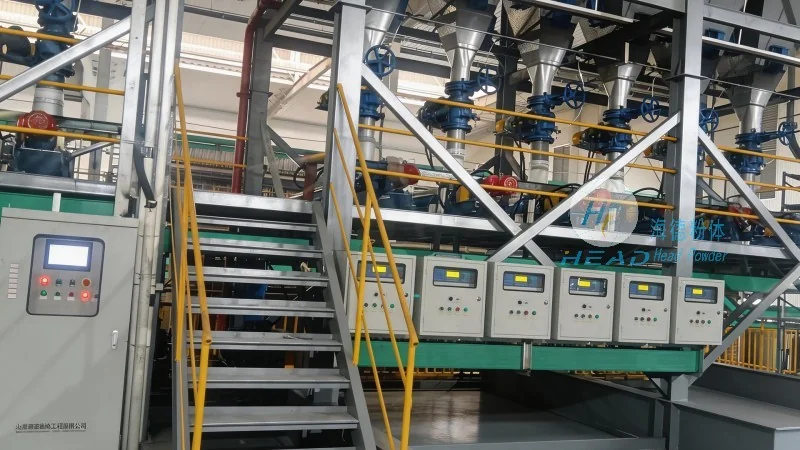
Pneumatic conveying uses compressed air or vacuum to suspend and transport material. It is suitable for conveying powders, fine granules, or liquid materials in battery production. For sensitive battery materials like lithium-ion battery cathode and anode active materials, pneumatic conveying can avoid material contact with the external environment, reducing contamination and oxidation. However, pneumatic conveying has higher energy consumption, potentially increasing operational costs for large-volume material transport. Additionally, the pneumatic conveying system requires complex pipeline design and filtration equipment, making maintenance relatively complex. HeadPowder's pneumatic conveying equipment features efficient filters and variable frequency control systems, optimizing air utilization efficiency and reducing energy consumption while ensuring the purity of material transport.
Vibrating Conveyor (Vibrating Conveyor)
A vibrating conveyor advances material forward by vibrating the trough using a vibrating motor or eccentric wheel. This method is suitable for materials with poor fluidity, such as sticky or moist battery materials. The vibrating conveyor has advantages like simple structure and no mechanical contact with material, reducing material damage. However, the conveying speed of the vibrating conveyor is relatively slow, which may not meet the requirements of high-volume production. Furthermore, the maintenance of the vibrating system requires professional technicians, with a relatively high failure rate. HeadPowder's vibrating conveyors use low-noise vibrating motors and wear-resistant vibrating troughs to improve material fluidity while reducing noise and vibration impacts on equipment.

Company Introduction: HeadPowder Engineering Solutions
As a professional manufacturer of battery material conveying equipment, Shandong HeadPowder Engineering Co., Ltd. (HeadPowder) is committed to providing efficient and reliable conveying solutions for clients. The company is located in Shandong, China, with years of industry experience and technical accumulation, capable of customizing conveying equipment based on specific client needs. HeadPowder's product line includes screw conveyors, belt conveyors, pneumatic conveyors, and vibrating conveyors, covering various types of battery material production requirements. The company emphasizes product quality and technological innovation, adopting advanced manufacturing processes and strict quality control systems to ensure stable performance and reliable operation of equipment. Whether for small-scale battery production lines or large-scale industrial battery manufacturing projects, HeadPowder can provide professional conveying equipment support to help clients optimize production processes and enhance production efficiency.

 Shandong Headpowder Engineering Co., Ltd.
 156-6277-7102(Quản lý Trương)
  0531-83386006
  Thành phố Tế Nam, Tỉnh Sơn Đông, Trung Quốc
Điện thoại
WeChatTư vấn
Lên đầu