Chuyên sâu trong lĩnh vực vật liệu rời công nghiệp, cung cấp giải pháp môi trường thông minh tích hợp cho phối trộn tự động, cấp liệu tập trung, khử lưu huỳnh và khử nitơ khô!
Denitration ash, also known as flue gas desulfurization (FGD) ash, is a byproduct generated during the flue gas treatment process in power plants and industrial facilities. Efficient and reliable ash conveying is crucial for the safe and economical operation of these systems. Various methods are employed for ash transport, each with distinct characteristics, advantages, and limitations. This article provides a detailed comparison of common denitration ash conveying methods, focusing on their operational principles, pros, and cons.

1. Air-Driven Pneumatic Conveying Systems
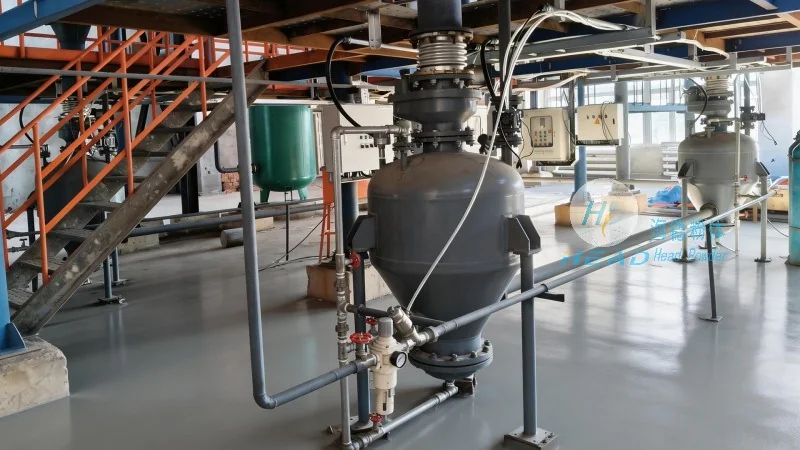
One of the most widely used methods for denitration ash transport is air-driven pneumatic conveying. This technology utilizes compressed air to transport ash particles through a pipeline network. The system typically consists of a hopper, a rotary valve, a conveying line, and a dust collector. The ash is fed into the hopper, then discharged into the conveying line via the rotary valve. Compressed air is introduced at the inlet of the line, creating a flow that propels the ash particles forward. The ash is then deposited at the destination, such as a storage silo or a disposal site.
Advantages of pneumatic conveying include high conveying capacity, flexibility in routing, and the ability to handle fine and abrasive particles. It is also relatively simple to install and maintain, as it does not require heavy machinery or complex mechanisms. The system can be easily integrated with existing plant infrastructure, making it a cost-effective solution for many applications.
However, pneumatic conveying has several drawbacks. One of the main disadvantages is the high energy consumption, as it requires a significant amount of compressed air. This can lead to increased operational costs, especially for large-scale plants. Additionally, the system is susceptible to blockages if the ash particles are too large or have high moisture content. The high air velocity can also cause wear and tear on the pipeline and components, leading to higher maintenance costs over time. Another concern is the potential for dust emissions, which may require additional filtration and environmental controls.
2. Mechanical Conveying Systems

Mechanical conveying systems, such as belt conveyors, screw conveyors, and bucket elevators, are another common method for denitration ash transport. These systems rely on mechanical power to move the ash through a series of components. Belt conveyors use a continuous belt to transport ash from the source to the destination. Screw conveyors utilize a rotating screw to push the ash forward, while bucket elevators use a series of buckets attached to a chain or belt to lift and transport the ash vertically.
Advantages of mechanical conveying include low energy consumption compared to pneumatic systems, as they do not require compressed air. They are also relatively simple to operate and maintain, with fewer moving parts compared to pneumatic systems. Mechanical conveyors can handle a wide range of ash types and sizes, including wet or sticky ash, which may be difficult for pneumatic systems to handle. They are also more reliable in terms of preventing blockages, as the mechanical action ensures continuous movement of the ash.
However, mechanical conveying has its own set of limitations. One of the main disadvantages is the limited conveying distance and height. Belt conveyors, for example, are typically limited to horizontal or slightly inclined routes, while bucket elevators are limited to vertical or near-vertical transport. This can be a challenge for plants with complex layouts or long distances between the ash source and disposal site. Mechanical conveyors are also more prone to wear and tear due to the direct contact between the ash and the conveying components, leading to higher maintenance costs. Additionally, they may not be suitable for handling very fine or abrasive ash particles, as this can cause excessive wear on the belt or screw.
3. Hydraulic Conveying Systems
Hydraulic conveying systems use water to transport denitration ash. The ash is mixed with water to form a slurry, which is then pumped through a pipeline to the destination. The system typically includes a slurry pump, a pipeline network, and a dewatering unit at the end of the line.
Advantages of hydraulic conveying include the ability to handle very fine ash particles and high moisture content. The slurry can be pumped over long distances and at high pressures, making it suitable for large-scale plants. The system is also relatively simple to operate and maintain, as it does not require complex machinery or compressed air. Additionally, it can be integrated with existing water treatment systems, reducing the need for additional infrastructure.

However, hydraulic conveying has several drawbacks. The main disadvantage is the high water consumption, as a significant amount of water is required to form the slurry. This can lead to increased operational costs and environmental concerns, especially in regions with water scarcity. The system is also susceptible to blockages if the ash particles are too large or have high viscosity. The slurry can also cause corrosion and wear on the pipeline and components, leading to higher maintenance costs. Another concern is the need for a dewatering unit at the end of the line, which adds complexity and cost to the system.
4. Comparison and Selection Criteria
When selecting a denitration ash conveying method, several factors must be considered, including the ash characteristics, conveying distance, plant layout, and operational costs. Pneumatic conveying is suitable for short to medium distances and for handling fine, dry ash. Mechanical conveying is ideal for long distances and for handling wet or sticky ash. Hydraulic conveying is best for very fine ash and for long-distance transport.
The choice of system also depends on the specific requirements of the plant. For example, a plant with a complex layout may require a combination of different conveying methods to achieve efficient transport. The cost of installation and maintenance must also be considered, as different systems have different capital and operational expenses.

 Shandong Headpowder Engineering Co., Ltd.
 156-6277-7102(Quản lý Trương)
  0531-83386006
  Thành phố Tế Nam, Tỉnh Sơn Đông, Trung Quốc
Điện thoại
WeChatTư vấn
Lên đầu