Chuyên sâu trong lĩnh vực vật liệu rời công nghiệp, cung cấp giải pháp môi trường thông minh tích hợp cho phối trộn tự động, cấp liệu tập trung, khử lưu huỳnh và khử nitơ khô!
Fluorspar powder, a vital raw material in industries such as metallurgy, glass manufacturing, and chemical production, demands efficient and reliable conveying systems to maintain seamless production workflows. The selection of a conveying method directly impacts operational efficiency, cost-effectiveness, and product quality. This article provides a comprehensive comparison of common fluorspar powder granule conveying methods, focusing on their advantages and disadvantages to assist in informed decision-making.
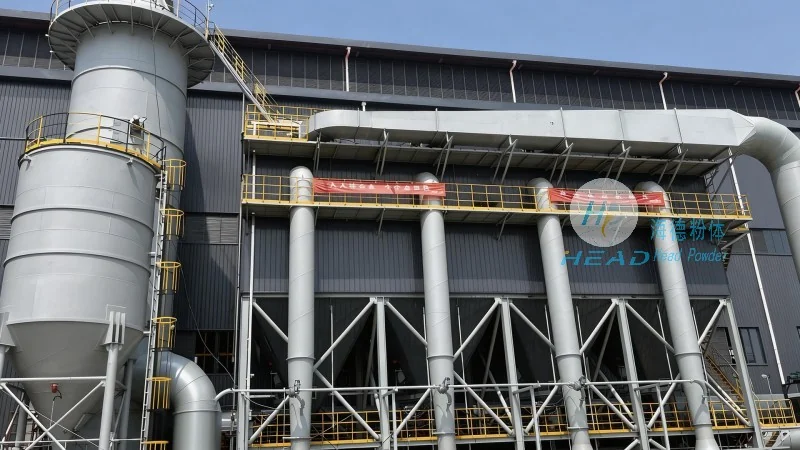
Company Profile: Shandong HeadPowder Engineering Co., Ltd.
As a leading enterprise in the material handling sector, Shandong HeadPowder Engineering Co., Ltd. specializes in designing, manufacturing, and supplying customized conveying solutions tailored to the unique requirements of clients. With a strong operational base in Shandong, China, the company leverages advanced technology and extensive industry expertise to deliver high-performance systems for fluorspar powder transport. Their commitment to quality, innovation, and customer satisfaction positions them as a trusted partner for businesses seeking reliable and efficient material handling solutions.
1. Pneumatic Conveying Systems
Pneumatic conveying is a widely adopted method for transporting fluorspar powder due to its ability to handle fine particles and provide a closed system for dust control. This technology utilizes air pressure to move material through pipelines, offering advantages such as low maintenance requirements, the capacity to transport materials over long distances, and the ability to integrate with existing production lines. The system is particularly effective for applications requiring a dust-free environment, as it prevents material exposure to external contaminants. However, pneumatic conveying may face challenges with high-pressure systems, which can increase energy consumption and maintenance costs. Additionally, the need for proper air filtration to prevent particle degradation and system clogging is essential, adding operational considerations. The efficiency of the system can also be affected by the moisture content of the powder, as excessive moisture can lead to reduced flow rates and increased wear on components.
2. Screw Conveyors

Screw conveyors represent another common solution for fluorspar powder transport, especially in applications involving horizontal or slight incline movement. These systems employ a rotating screw to push material forward, making them suitable for moderate particle sizes and low to medium flow rates. The primary advantages include simple design, low operational costs, and the ability to handle a wide range of materials without additional components. Screw conveyors are also relatively easy to install and maintain, making them a cost-effective option for many industrial settings. Nevertheless, they may struggle with very fine or abrasive powders, as the screw and housing can experience accelerated wear over time. The risk of material bridging or clogging is higher in some cases, particularly with cohesive or moist powders. Furthermore, screw conveyors are less effective for vertical lifting compared to other methods, limiting their use in applications requiring significant elevation changes.
3. Belt Conveyors
Belt conveyors are ideal for bulk material handling, including fluorspar powder, due to their high capacity and ability to transport materials over long distances horizontally. These systems utilize a continuous belt to move material, offering advantages such as high throughput, low maintenance, and the flexibility to include multiple loading and unloading points. Belt conveyors are particularly effective for large-scale operations where consistent and continuous transport is critical, such as in mining and processing facilities. However, they may not be suitable for very fine powders, as the belt can cause particle segregation or loss of material during transport. The system also requires regular tension checks and cleaning to prevent belt wear and material buildup, which adds to operational considerations. Additionally, belt conveyors are susceptible to damage from heavy or sharp particles, necessitating protective measures to ensure longevity.
4. Hydraulic Conveying

Hydraulic conveying systems offer a unique approach to fluorspar powder transport by utilizing water or other fluids to move material through pipelines. This method is particularly effective for fine powders and can handle high volumes with minimal pressure requirements, making it suitable for applications where low energy consumption is a priority. The main advantages include the ability to transport materials through pipelines with minimal wear, the capacity to mix materials with the conveying fluid for processing, and the reduced risk of dust generation compared to pneumatic systems. However, hydraulic systems require careful maintenance to prevent fluid contamination and clogging, as any impurities can significantly impact performance. The need for additional equipment for fluid recycling and treatment adds to operational complexity and cost. The efficiency of the system is also dependent on the particle size and density, as larger or denser particles may not be transported as effectively, potentially leading to reduced throughput.
Conclusion and Recommendations
Choosing the appropriate conveying method for fluorspar powder depends on several key factors, including particle size, flow rate, distance, environmental regulations, and budget constraints. Pneumatic systems excel in closed systems and fine particle handling, while screw conveyors provide simplicity for moderate applications. Belt conveyors are ideal for bulk and long-distance transport, and hydraulic systems offer a specialized solution for specific material characteristics. Shandong HeadPowder Engineering Co., Ltd. recommends conducting a thorough analysis of these factors to select the most suitable conveying method, ensuring optimal performance, cost-effectiveness, and compliance with operational requirements in fluorspar powder handling operations.

 Shandong Headpowder Engineering Co., Ltd.
 156-6277-7102(Quản lý Trương)
  0531-83386006
  Thành phố Tế Nam, Tỉnh Sơn Đông, Trung Quốc
Điện thoại
WeChatTư vấn
Lên đầu