

Common Gypsum Particle Conveying Methods: An Introduction to Gypsum Particle Pneumatic Conveying
Gypsum, a widely used industrial material, often needs to be transported from one location to another during processing or distribution. The efficiency and reliability of the conveying system directly impact production efficiency and operational costs. Among various methods, pneumatic conveying stands out as a key technology for handling gypsum particles due to its flexibility and effectiveness. This article explores common gypsum particle conveying methods, with a focus on pneumatic systems.

About HeadPowder: Your Gypsum Conveying Solution Provider
HeadPowder, operating under the full name Shandong HeadPowder Engineering Co., Ltd., is a leading company based in Shandong, China. With years of experience in the field, HeadPowder specializes in designing and manufacturing advanced conveying solutions tailored to the unique needs of gypsum processing industries. Our expertise ensures that clients receive systems that are not only efficient but also durable and cost-effective.
1. Gravity Conveying: A Basic Approach
Gravity conveying is one of the simplest methods for transporting gypsum particles. It relies on the natural force of gravity to move materials down a sloped conveyor or chute. This method is typically used for short distances and when the material is relatively free-flowing. While simple and low-cost, gravity conveying has limitations, such as requiring a steep incline and being unsuitable for long distances or for materials with high moisture content. It is often used as a preliminary step in larger conveying systems.
2. Mechanical Conveying: Reliability and Control
Mechanical conveying systems, including belt conveyors, screw conveyors, and bucket elevators, are widely used in gypsum handling. These systems use mechanical components to move particles through a pipeline or along a belt. Belt conveyors are particularly effective for transporting gypsum over longer distances and at higher capacities. Screw conveyors, on the other hand, are ideal for vertical or horizontal transport in confined spaces. Mechanical systems offer good control over the flow rate and direction of the material, making them suitable for various applications. However, they may require more maintenance and are less flexible compared to pneumatic systems.

3. Pneumatic Conveying: The Preferred Method for Gypsum
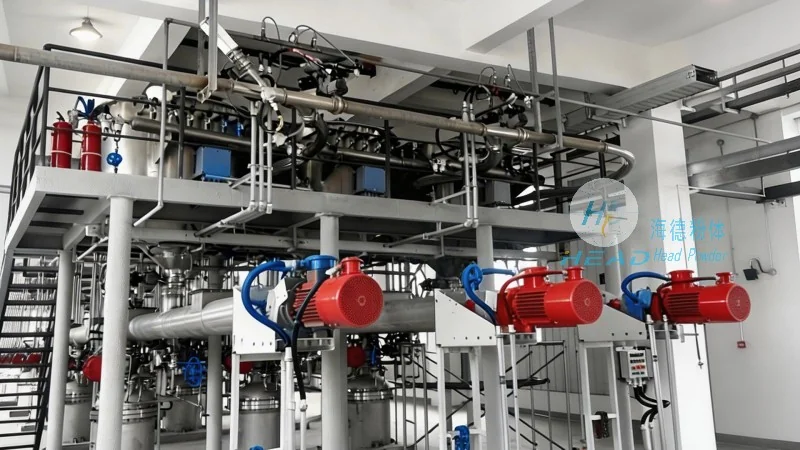
Pneumatic conveying, also known as air conveying, is the most common and efficient method for transporting gypsum particles. This technology uses compressed air to move materials through a pipeline. There are two main types of pneumatic conveying: dilute-phase and dense-phase. Dilute-phase systems use low air velocities to transport particles in a dispersed state, making them suitable for short to medium distances. Dense-phase systems, on the other hand, use higher air velocities and lower air-to-material ratios to transport particles in a more concentrated state, which is ideal for longer distances and for handling materials that are prone to caking or segregation.
HeadPowder specializes in designing custom pneumatic conveying systems that optimize performance for gypsum applications. Our systems are engineered to handle the specific characteristics of gypsum, such as its particle size, moisture content, and flowability. By using advanced control systems and high-quality components, we ensure that our pneumatic conveying solutions provide consistent and reliable transport, minimizing downtime and operational costs.
Conclusion: Choosing the Right Conveying Method for Gypsum
The choice of gypsum particle conveying method depends on several factors, including the distance to be covered, the material's properties, and the required capacity. Gravity and mechanical systems have their place in certain applications, but for most industrial scenarios, pneumatic conveying offers superior performance and flexibility. HeadPowder, with its expertise and commitment to quality, provides tailored pneumatic conveying solutions that meet the diverse needs of gypsum processing industries. By selecting the right conveying method, businesses can enhance productivity, reduce costs, and ensure the smooth operation of their gypsum handling processes.