

Common Methods for Transporting Ternary Cathode Materials: An Introduction to Pneumatic Conveying of
In the manufacturing of lithium-ion batteries, ternary cathode materials serve as key active substances, and their efficient, safe transport directly impacts production efficiency and product quality. With continuous advancements in battery technology, the transport technology for ternary cathode materials has evolved from traditional methods to modern advanced technologies. This article focuses on common transport methods for ternary cathode materials and introduces pneumatic conveying as an efficient, environmentally friendly transport method, providing reference for process optimization in battery production enterprises.
Ternary Cathode Material Transport Importance and Challenges
Ternary cathode materials, typically composed of nickel, cobalt, manganese or nickel, cobalt, aluminum oxides, possess high energy density and good cycle performance, serving as the core component of modern lithium-ion batteries. However, these materials often exist as powders or micro-particles during preparation and processing, exhibiting characteristics such as easy dusting, easy oxidation, and easy moisture absorption, which pose challenges to the transport process. Traditional transport methods like belt conveyors and screw conveyors may cause dust dispersion, equipment wear, and environmental pollution when handling flammable, explosive, and high-purity ternary cathode materials. Therefore, developing efficient, safe, and environmentally friendly transport technologies is a key task for battery manufacturing enterprises.
Overview of Common Ternary Cathode Material Transport Methods
Currently, transport methods for ternary cathode materials mainly include mechanical and pneumatic transport. Mechanical transport, such as belt conveyors and screw conveyors, uses mechanical force to transport materials from one location to another, suitable for larger particles with good flowability. However, for fine powders of ternary cathode materials, mechanical transport easily leads to dust dispersion and may mix impurities during transport, affecting material purity. In contrast, pneumatic transport suspends and transports materials by mixing them with air to form a gas-solid two-phase flow through pipelines, offering advantages like no mechanical contact, fast transport speed, and enclosed transport, especially suitable for high-purity, dust-prone powder materials.

Detailed Explanation of Ternary Cathode Material Pneumatic Conveying
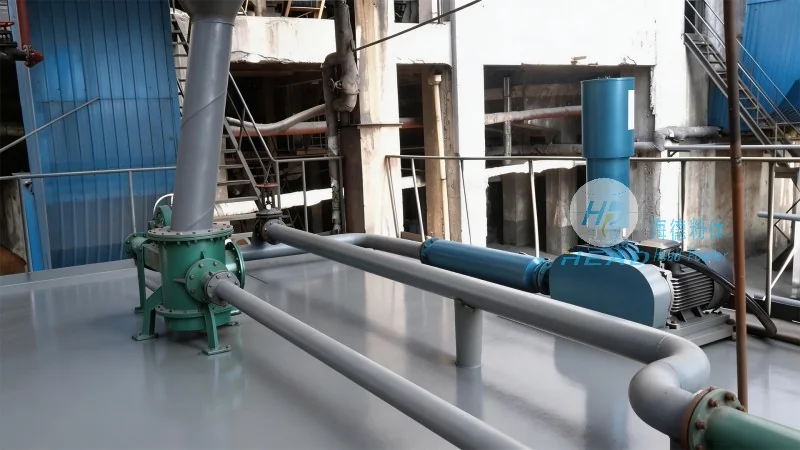
Pneumatic conveying utilizes compressed air or vacuum as a power source to transport solid particle materials mixed with air as a gas-solid two-phase flow through pipelines. For ternary cathode materials, pneumatic conveying systems typically include feeders, transport pipelines, separation devices, and receiving equipment. Specifically, pneumatic conveying is divided into suction and pressure types. Suction systems generate negative pressure with vacuum pumps to draw materials from hoppers into transport pipelines; pressure systems use blowers or compressors to press materials from hoppers into transport pipelines. In the pneumatic conveying of ternary cathode materials, pressure systems are usually adopted because they have stable pressure, longer transport distances, and are less affected by external environmental interference.
Pneumatic conveying system key equipment includes hoppers, feeders, transport pipelines, separators (such as cyclone separators or bag filters), and receiving tanks. Hoppers are used to store ternary cathode materials, while feeders uniformly and continuously feed materials into the transport pipelines. Transport pipelines are typically made of corrosion-resistant and wear-resistant materials like stainless steel or plastic to adapt to the high purity and chemical stability requirements of ternary cathode materials. Separation devices are used to separate the transported air from the material to ensure effective collection and prevent dust leakage. Receiving tanks store the transported ternary cathode materials for subsequent mixing and forming processes.
Advantages of Pneumatic Conveying in Ternary Cathode Material Transport

Compared to mechanical transport, pneumatic conveying has significant advantages in the transport of ternary cathode materials. First, pneumatic conveying is an enclosed transport, effectively preventing dust dispersion and reducing the impact on operators and the environment, meeting modern industrial environmental requirements. Second, pneumatic conveying has a fast transport speed, improving production efficiency and reducing material residence time in the production line. Additionally, pneumatic conveying systems can flexibly adjust transport volume according to production needs, adapting to changes in production scale. For high-purity ternary cathode materials, the enclosed and non-mechanical contact characteristics of pneumatic conveying effectively avoid material contamination, ensuring material purity, which is crucial for battery performance.
HeadPowder's Application Practice in Pneumatic Conveying of Ternary Cathode Materials
Shandong HeadPowder Engineering Co., Ltd. (HeadPowder), as a professional powder engineering solutions provider, has rich experience and technical accumulation in the pneumatic conveying of ternary cathode materials. The company focuses on providing customized pneumatic conveying system solutions for battery manufacturing enterprises based on customer production scale, material characteristics, and process requirements. HeadPowder's pneumatic conveying systems adopt advanced control technology and materials to ensure stable, efficient, and safe transport. For example, the company designed a pneumatic conveying system for a battery enterprise, optimizing pipeline diameter and air flow speed to achieve efficient material transport, while the effective design of the separator ensured material purity and recovery rate. The system not only improved production efficiency but also reduced operator labor intensity and environmental pollution, bringing significant economic benefits to customers.
Conclusion and Outlook
Pneumatic conveying as an efficient and environmentally friendly transport method plays an increasingly important role in the manufacturing of lithium-ion batteries. With continuous development of battery technology and increasing requirements for material purity and production efficiency, pneumatic conveying technology will be further improved and popularized. HeadPowder, as a professional manufacturer in the industry, will continue to provide high-quality pneumatic conveying solutions for battery manufacturing enterprises to assist in technological progress and sustainable development of the industry.