

Common Ceramic Particle Conveying Methods: Introduction to Pneumatic Conveying of Ceramic Particles
When it comes to handling and transporting ceramic particles, selecting the right conveying method is crucial for efficiency, cost-effectiveness, and product integrity. Ceramic particles, often used in industries such as ceramics, electronics, and pharmaceuticals, require specialized equipment to ensure safe and reliable transport. This article explores common ceramic particle conveying methods, with a focus on the advantages and applications of pneumatic conveying systems.
Understanding Ceramic Particle Conveying

Ceramic particles are characterized by their hardness, high density, and sometimes abrasive nature. These properties make traditional conveying methods, like belt conveyors or screw conveyors, less suitable due to potential wear and damage to both the equipment and the particles. As a result, specialized systems are often employed to maintain the quality and consistency of ceramic materials during transport.
Common Conveying Methods for Ceramic Particles
Several methods are used to transport ceramic particles, each with its own set of advantages and limitations. The choice of method depends on factors such as particle size, flow rate, distance, and the specific requirements of the application.

Pneumatic Conveying: The Preferred Solution for Many Applications
Pneumatic conveying, also known as air conveying, is a widely used method for transporting ceramic particles. This system uses compressed air to move particles through a pipeline. There are two main types of pneumatic conveying: dilute phase and dense phase.
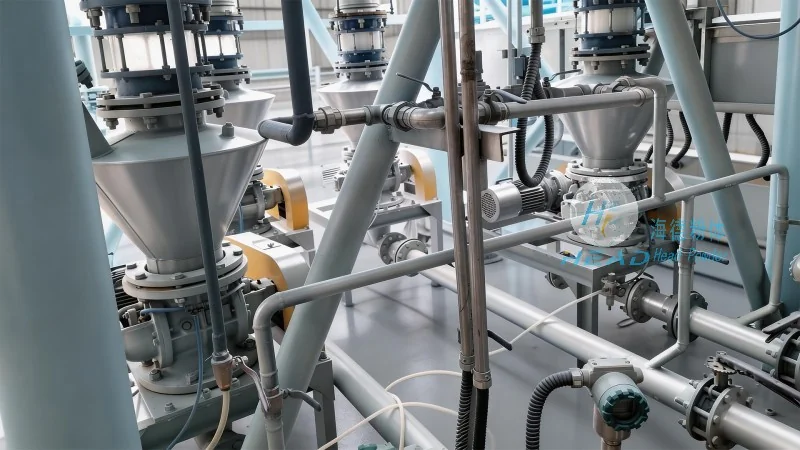
Dilute phase pneumatic conveying is suitable for fine particles and short to medium distances. In this method, particles are suspended in a stream of air and transported through the pipeline. It is efficient for low to medium flow rates and is often used in applications where the particles are not too abrasive.
Dense phase pneumatic conveying, on the other hand, is ideal for handling larger particles or when a higher pressure is required. In this system, particles are conveyed in a slurry-like state, with a higher concentration of particles in the air stream. This method is more suitable for longer distances and higher flow rates, as it reduces the risk of particle degradation and equipment wear.
Advantages of Pneumatic Conveying for Ceramic Particles

There are several key advantages to using pneumatic conveying for ceramic particles. First, it is a closed system, which helps to contain dust and prevent contamination, a critical factor in industries where product purity is essential. Second, pneumatic systems can handle a wide range of particle sizes and shapes without causing damage. Third, they are flexible and can be easily integrated into existing production lines. Finally, pneumatic conveying can be more energy-efficient than some other methods, especially for shorter distances.
Applications of Ceramic Particle Pneumatic Conveying
Pneumatic conveying systems are used in a variety of applications involving ceramic particles. In the ceramics industry, they are used to transport raw materials such as clay, feldspar, and silica to production lines. In the electronics industry, they are used to convey powders for the manufacturing of components like capacitors and resistors. In the pharmaceutical industry, they are used to transport powders for drug formulation and packaging.
Conclusion
Choosing the right conveying method for ceramic particles is essential to ensure efficient and reliable transport. Pneumatic conveying, particularly in its dense phase form, is often the preferred solution due to its ability to handle abrasive and high-density particles while maintaining product quality. Companies like Shandong HeadPowder Engineering Co., Ltd., based in Shandong, China, specialize in providing customized pneumatic conveying systems tailored to the specific needs of ceramic particle handling in various industries.