

[CUSTOM METHODS FOR PVC POWDER CONVEYANCE]
When it comes to the efficient handling and transportation of PVC powder, selecting the right conveying method is crucial for maintaining product quality, ensuring operational safety, and optimizing production processes. As a leading provider in the field, Shandong HeadPowder Engineering Co., Ltd. (commonly known as HeadPowder) specializes in delivering tailored solutions for various industrial applications. This article explores the most common methods used for PVC powder conveyance, highlighting their advantages, limitations, and typical applications.

1. Air-Pneumatic Conveying Systems
Air-pneumatic conveying, also known as pneumatic conveying, is one of the most widely used methods for transporting PVC powder due to its ability to handle fine powders with minimal product degradation. This system operates by using compressed air to create a flow of material through a pipeline. The primary types include pressure and vacuum systems. Pressure systems use positive pressure to push the material forward, while vacuum systems use negative pressure to draw the material into the line. For PVC powder, which is often sensitive to moisture and contamination, air-pneumatic conveying offers a closed system that prevents exposure to external elements. This method is particularly effective for long-distance transport and can handle both low and high volumes of material. However, it requires careful control of air pressure and flow rates to avoid clogging or excessive wear on components. HeadPowder's expertise in designing and manufacturing custom air-pneumatic systems ensures that clients receive solutions optimized for their specific PVC powder characteristics and operational requirements.
2. Screw Conveyors

Screw conveyors, or auger conveyors, are another common method for PVC powder transport, especially in applications where horizontal or slight incline movement is needed. These systems consist of a rotating screw (auger) enclosed in a tube or trough, which moves the material along the length of the conveyor. Screw conveyors are highly effective for handling dry, free-flowing powders like PVC, as they provide a continuous, low-speed transport with minimal product breakage. They are also relatively simple in design, making them cost-effective and easy to maintain. The key advantage of screw conveyors is their ability to handle a wide range of particle sizes and moisture contents without the need for additional equipment. However, they may not be suitable for very fine or cohesive powders, as these can lead to blockages or increased wear on the screw and trough. For applications requiring gentle handling, screw conveyors are an excellent choice, and HeadPowder offers a range of screw conveyor solutions tailored to different production scales and material properties.
3. Belt Conveyors
Belt conveyors are widely used in bulk material handling, including PVC powder, due to their ability to transport large quantities of material over long distances with high efficiency. These systems consist of a continuous belt that moves over rollers or pulleys, carrying the PVC powder from one point to another. Belt conveyors are particularly effective for horizontal or slightly inclined transport and can handle a wide variety of materials, including powders, granules, and even bulk solids. One of the main advantages of belt conveyors is their high capacity and low maintenance costs, making them ideal for continuous production lines. They are also relatively simple to install and can be integrated with other equipment, such as feeders and classifiers, to form a complete conveying system. However, belt conveyors may not be suitable for very fine powders, as they can cause dust issues and require regular cleaning to prevent material buildup. Additionally, they may not be as effective for vertical transport or steep inclines compared to other methods. HeadPowder's expertise in conveyor system design ensures that clients receive belt conveyor solutions that meet their specific operational needs, including material flow rates, distance, and environmental considerations.
4. Hydraulic Conveying
Hydraulic conveying systems use a liquid medium, typically water or a specialized fluid, to transport PVC powder. This method is particularly useful for handling abrasive or corrosive powders, as the liquid acts as a lubricant and protective medium. The system operates by pumping the liquid through a pipeline, with the powder suspended in the liquid stream. Hydraulic conveying is highly effective for long-distance transport and can handle large volumes of material with minimal energy consumption. However, it requires a closed system to prevent liquid leakage and contamination, which can be a challenge in industrial settings. Additionally, the liquid must be properly treated and recycled to avoid environmental issues. For applications where other methods are not feasible, such as transporting highly abrasive PVC powders, hydraulic conveying offers a reliable solution. HeadPowder's experience in hydraulic system design allows them to provide customized solutions that ensure efficient and safe transport of PVC powder, even in challenging conditions.
5. Vibratory Conveyors
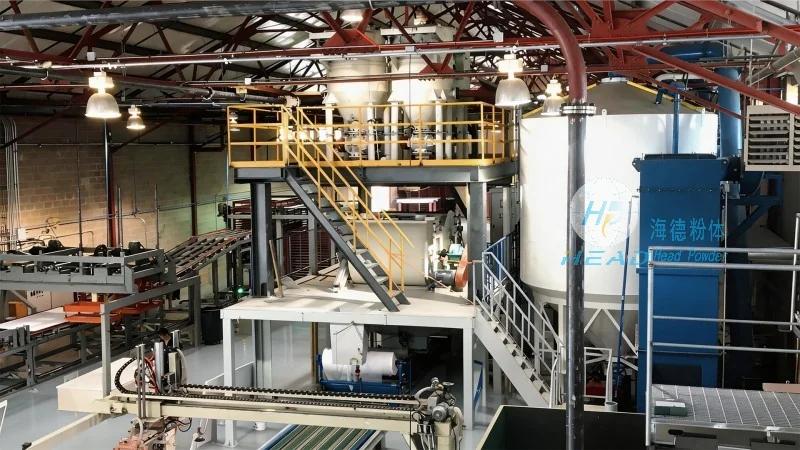
Vibratory conveyors use vibration to move PVC powder along a trough or conveyor bed. These systems consist of a conveyor trough that is mounted on springs and driven by an electric motor, which creates a shaking motion. The vibration causes the powder to move forward, with the speed and amplitude of the vibration adjustable to control the material flow rate. Vibratory conveyors are particularly effective for handling cohesive or sticky powders, as the vibration helps to break up clumps and prevent blockages. They are also suitable for horizontal or slight incline transport and can handle a wide range of particle sizes. The main advantage of vibratory conveyors is their gentle handling of materials, which minimizes product degradation and maintains quality. However, they may not be as efficient for very fine powders, as the vibration can cause excessive dust generation. Additionally, the system requires regular maintenance to ensure the vibration mechanism operates smoothly. HeadPowder's expertise in vibratory conveyor design ensures that clients receive systems optimized for their specific PVC powder characteristics, including particle size, moisture content, and flow properties.
6. Pneumatic and Mechanical Combination Systems
In some cases, a combination of pneumatic and mechanical conveying methods is used to address the limitations of each individual system. For example, a system might use a screw conveyor to feed PVC powder into a pneumatic conveying line, or a belt conveyor to transport material to a vibratory feeder. These hybrid systems are particularly useful for complex production lines where multiple material handling steps are required. The combination of methods allows for greater flexibility and efficiency, as each component can be optimized for its specific function. For instance, a screw conveyor can handle the initial feeding of powder, while a pneumatic system transports it to the processing area. This approach minimizes material loss and ensures consistent flow rates. HeadPowder specializes in designing and manufacturing combination systems that integrate the best features of different conveying methods, providing clients with tailored solutions that meet their unique operational challenges.
Choosing the right PVC powder conveying method depends on several factors, including the material's properties (such as particle size, moisture content, and flowability), the distance and direction of transport, the required capacity, and the overall production environment. Shandong HeadPowder Engineering Co., Ltd. (HeadPowder) offers comprehensive expertise in evaluating these factors and recommending the most suitable conveying solutions. By leveraging their experience in designing and manufacturing custom systems, HeadPowder ensures that clients receive efficient, reliable, and cost-effective solutions for their PVC powder handling needs. Whether using air-pneumatic, screw, belt, hydraulic, vibratory, or combination systems, HeadPowder's commitment to quality and innovation helps industries maintain productivity and product quality in PVC powder processing.