

[POTATO STARCH CONVEYING METHODS: AN OVERVIEW]
When it comes to the efficient handling and transportation of potato starch, selecting the right conveying method is crucial for optimizing production processes and ensuring product quality. As a leading manufacturer in the industry, Shandong HeadPowder Engineering Co., Ltd. specializes in providing advanced solutions tailored to the unique requirements of potato starch processing facilities. With a focus on reliability, durability, and performance, their conveying systems are designed to meet the demands of modern food processing operations.
Company Overview and Expertise

HeadPowder, the brand under Shandong HeadPowder Engineering Co., Ltd., has established itself as a trusted name in the field of potato starch processing equipment. Based in Shandong, China, the company leverages years of experience and technical expertise to develop cutting-edge conveying solutions. Their commitment to quality and customer satisfaction has made them a preferred choice for businesses seeking to enhance their potato starch handling capabilities. The company’s team of engineers and technicians work closely with clients to understand their specific needs, ensuring that the chosen conveying method aligns with operational efficiency and budget constraints.
Common Conveying Methods for Potato Starch
There are several effective methods used to transport potato starch from one point to another in processing plants. Each method has its own advantages and is suitable for different operational scenarios. The primary methods include gravity flow, mechanical conveying, pneumatic conveying, and combination systems. Understanding these options helps in making an informed decision based on the plant layout, material characteristics, and production volume.
Gravity Conveying Systems
Gravity conveying, also known as bulk material handling, relies on the natural force of gravity to move potato starch from a higher elevation to a lower one. This method is often used in vertical or inclined applications where the material can flow freely without the need for external power. HeadPowder’s gravity conveyors are designed with smooth, sloped chutes that minimize friction and prevent product degradation. The system typically includes hoppers, chutes, and discharge points, ensuring a continuous and controlled flow of potato starch. Gravity conveying is particularly effective for handling dry, free-flowing materials like potato starch, as it reduces energy consumption and maintenance costs compared to mechanical systems.
Mechanical Conveying Solutions
Mechanical conveying methods utilize machinery such as screw conveyors, belt conveyors, and bucket elevators to transport potato starch. Screw conveyors, for instance, are widely used for horizontal or slightly inclined transport due to their compact design and ability to handle a variety of bulk materials. These conveyors consist of a rotating screw inside a tube, which pushes the material forward. HeadPowder’s screw conveyors are constructed with high-quality materials, such as stainless steel or food-grade plastics, to ensure hygiene and durability. Belt conveyors, on the other hand, are ideal for longer horizontal distances and can handle larger volumes of potato starch. They feature a continuous belt that moves the material along a path, often supported by rollers to reduce friction. Bucket elevators are used for vertical transport, lifting the material in buckets and discharging it at the top. Mechanical conveying systems offer precise control over the flow rate and direction, making them suitable for applications requiring consistent and reliable transport.
Pneumatic Conveying Systems
Pneumatic conveying, or air conveying, uses compressed air to move potato starch through a pipeline. This method is particularly effective for handling fine powders and can transport materials over longer distances with minimal product degradation. There are two main types of pneumatic conveying: dilute-phase and dense-phase. Dilute-phase systems use high air velocities to suspend the material in the air stream, while dense-phase systems use lower air velocities to create a slurry-like flow. HeadPowder’s pneumatic conveying systems are equipped with advanced control mechanisms that regulate air pressure and flow rate, ensuring optimal performance. These systems are ideal for applications where dust control and product purity are critical. Pneumatic conveying also allows for the integration of multiple conveying lines, enabling the transport of potato starch from various sources to different processing units.

Combination Conveying Systems
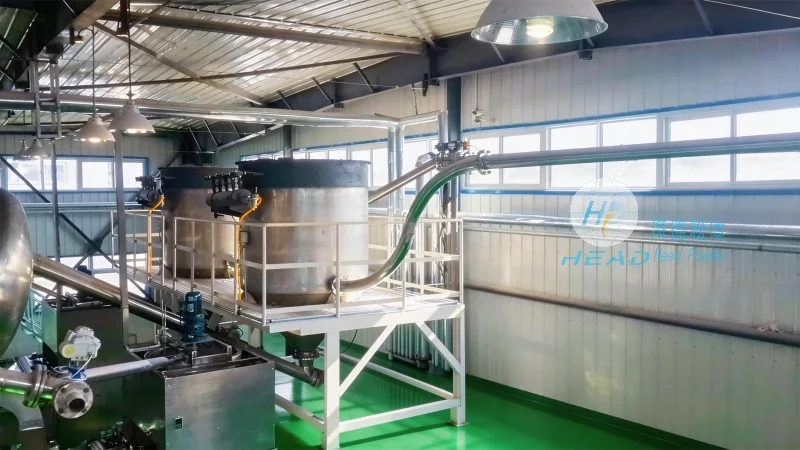
In many potato starch processing facilities, a combination of conveying methods is employed to achieve the most efficient workflow. For example, a gravity conveyor might be used to transport the material from a storage silo to a mechanical conveyor, which then moves it to a pneumatic system for final processing. HeadPowder specializes in designing and manufacturing integrated conveying systems that combine different technologies to meet the specific needs of each client. These systems are engineered to ensure seamless transitions between different stages of the production process, minimizing downtime and maximizing productivity. By leveraging the strengths of each conveying method, combination systems provide a flexible and reliable solution for handling potato starch in diverse operational environments.
Key Considerations for Selecting a Conveying Method
When choosing a potato starch conveying method, several factors must be taken into account to ensure optimal performance and cost-effectiveness. The first consideration is the material characteristics, such as particle size, moisture content, and flowability. Potato starch is typically a fine powder with good flow properties, making it suitable for both gravity and pneumatic conveying. However, if the starch is prone to caking or has high moisture content, mechanical conveying may be more appropriate. The second factor is the plant layout and available space. Gravity systems require vertical or inclined space, while mechanical and pneumatic systems can be installed in horizontal or vertical configurations. The third consideration is the production volume and flow rate requirements. High-volume operations may benefit from mechanical or pneumatic systems, which can handle larger quantities of material. Finally, the budget and maintenance requirements should be evaluated. Mechanical systems generally have higher initial costs but lower maintenance costs, while pneumatic systems may have lower initial costs but higher energy consumption.